

Special features:
#SIFA2026


TLDR; The grad show peels back the curtain to reveal backstage labour. It peels back theatrical training itself, making students examine how they learned to perform and make theatre.
The show becomes theatre reflecting on theatre — a loop, mirror, recursion, self-exposure.

Backstage Protocol unfolds as a non-linear collage, beginning not with presence, but with absence. Surtitles narrate what happens behind the curtain—movements we cannot see, cues and the shuffling of feet that we sometimes hear. The theatre, before anything else, is revealed as a system: of timing, coordination, and unseen labour. What is usually peripheral becomes the frame.
The work sets out to surface the invisible—stage managers, technicians, designers, even the role of the janitor—those who sustain the making of a theatre work without occupying its centre.
The production could have remained at simply revealing these unsung roles. Instead, director Selena Lu weaves in another narrative strand that feels not just apt, but almost necessary for a graduating cohort from NAFA Diploma in Theatre (Mandarin Drama). The students revisit A Doll’s House, the very text they encountered in their first year in this same black box. Fragments of past performances re-emerge, refracted through time and training.
As the students toggle between reprising Nora and other characters, and adjusting light cues, moving furniture, or reflecting on the original sound design of A Doll’s House, the work begins to layer process with hindsight. There are moments where they actively reconsider past decisions—how a light might isolate Nora or spotlight a fleeting expression, how a sonic texture might redirect attention. In doing so, the production reveals how backstage design does more than support: it contours, reframes, and at times even displaces the performer as the primary storyteller. It becomes clear that meaning on stage is not carried by the performer alone, but is equally shaped through light, sound, and spatial intervention—tools that can, when wielded deliberately, carry as much narrative force as text or performance. What is typically treated as support begins to assert its own authorship.

Seen in this light, the production feels less like an experimental detour and more like a culmination of the training the students have undergone. The non-linear, devised structure echoes the programme’s shift toward contemporary practices, where students are positioned not only as performers but as makers—negotiating text, space, and authorship. Their ability to move between acting and stagecraft is not incidental, but reflective of a curriculum that embeds technical literacy alongside performance, asking them to understand how meaning is constructed across light, sound, and scenography. Even the return to A Doll’s House—revisited, reframed, and reworked—signals a pedagogical loop: from learning to inhabit a text, to interrogating it, and finally to re-authoring it through process. What emerges is a cohort not simply demonstrating skill, but testing their agency within the structures they have been trained in.
In these shifts, the boundaries between actor and backstage practitioner begin to dissolve. Theatre is no longer a fixed hierarchy of roles, but a circulation of labour, authorship, and attention. The performance moves fluidly between demonstration and reflection: scenes are devised, interrupted, resumed. Bodies slip between being seen and facilitating what is seen.

These transitions are not always smooth. The collage structure resists a linear build, and at times diffuses its own tensions. In one extended sequence, the monotony of backstage waiting is rendered through a playful act of “catching Pokémon”: student-performers in headset gear roam the stage with paper puppets and handheld torches, while intelligent lighting patterns mark each capture with shrinking pools of light and game-like sound effects. The scene is witty and technically inventive, turning idle labour into choreography, yet it also deliberately interrupts narrative momentum. Such moments reveal the work’s interest less in dramatic escalation than in exposing the textures, rhythms, and absurdities of theatrical labour itself. Yet within this fragmentation lies a more generative question: not simply who is visible, but who determines visibility. The work gestures toward protocols—not just as rules, but as inherited systems of behaviour that shape how and what kind of theatre is made, and by whom.
In this sense, Backstage Protocol is less a performance than a proposition. It asks what it means to participate in an institution where roles are pre-determined, yet constantly negotiated in practice. And whether, in the act of making theatre together, one might begin to rewrite the very structures that organise it.
For a graduating cohort, these questions feel especially urgent. Beyond technical (acting) training, the work opens up a space for reflection—on the kind of theatre they wish to make, the roles they choose to inhabit or resist, and how these choices might shift across contexts, whether in Singapore or back in their own cultural landscapes.
------
Show attended:
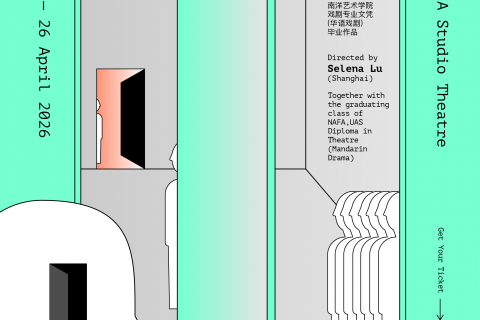
Backstage Protocol
by Emergency Stairs & Nanyang Academy of Fine Arts (NAFA) Diploma in Theatre (Mandarin Drama)
Date: 24 April 2026
Venue: NAFA Studio Theatre
 Singapore Writers Festival – Marina Mahathir in Conversation with Catherine Lim
![[Review] You Can Reach The Sky brings the stars down so that the children may touch it](/assets/Uploads/_resampled/FillWyI0ODAiLCIzMjAiXQ/11-20190110-review-you-can-reach-the-sky-03.jpg) [Review] You Can Reach The Sky brings the stars down so that the children may touch it
[Review] You Can Reach The Sky brings the stars down so that the children may touch it
 Singapore Writers Festival – Panel Discussion: Translation in Theatre / 座谈会:剧场中的翻译


![[Review] Backstage Protocol — Visible Labour, Invisible Lessons: The Stage as Self-Reflection Negotiating the Cycle of Expressing, Experiencing, Portraying, Reflection and Making](/assets/Thumbs/_resampled/FillWyI0ODAiLCIzMjAiXQ/review-backstage-protocol-tn.jpg)
 Facebook
 Instagram